
LUMICKO’s Democratisation of Creativity Reframing Student Work
Subang Jaya– When LUMICKO went live, it did not arrive with the language of disruption or the grandstanding rhetoric often attached to new platforms. There were no promises to “reinvent” education, no claims of replacing existing systems.
Instead, its significance lay in something quieter and more radical: it made student work visible in a way that refused to frame it as practice. What appeared on screen were not drafts or classroom exercises, but finished broadcasts, documentaries, campaigns, podcasts, and films– work that asked to be judged on its own merit, not on the age or status of its creators.

In higher education, particularly with creative disciplines, student work has long occupied an unstable position. It is labour-intensive, intellectually demanding, and often emotionally charged, yet structurally disposable. Once graded, it is archived, forgotten, or deleted. The system implicitly teaches students that their most ambitious efforts exist only temporarily– valuable enough to access, but not valuable enough to endure. LUMICKO intervenes precisely at this moment of disappearance, reframing student work not as stepping stone, but as contribution.
The platform, launched by Taylor’s University, functions as a public streaming space dedicated exclusively to student-created content. Anyone can watch it: peers, parents, lecturers, employers, policymakers, or standers who happen to stumble across it. That openness is not incidental. It is the core of the project. By removing the walls that traditionally separate classrooms from the wider world, LUMICKO collapses the distinction between learning and doing, between trending and participation. Student work no longer exists in rehearsal mode. It exists live.
Ms. Prema Ponnudurai, who founded LUMICKO and now serves as Head of School for General Studies and Languages at Taylor’s, spoke about the project with a clarity shaped by long observation rather than sudden inspiration. “A lot of youth-centered content never sees the light of day,” she said during the launch. “If you don't have an agent, if you don’t have finding, if you don't already know someone in the industry, your work just disappears.” Her words pointed to a structural imbalance that LUMICKO seeks to address; one where access, rather than ability, determines whose work is seen.

The name itself gestures towards that intention. Derived from ideas of light and echo, LUMICKO is meant to illuminate student voices and allow them to reverberate beyond the moment of assessment. It acknowledges that talent does not begin at employment, and that creative identity is not something that suddenly materialises at graduation. It is formed earlier, shaped though experimentation, failure, revision, and persistence. What LUMICKO offers is continuity– a space where that development can be seen rather than erased.
This visibility matters because the creative economy has changed. In 2025, employability is increasingly tied to platforms. Recruiters, producers, editors, and agencies no longer rely solely on qualifications; they look for proof. Links, reels, clips, and portfolios circulate alongside CVs, often carrying more weight than transcripts ever could. Yet for many students, especially those without industry connections, assembling that proof is difficult. Work lives on hard drives, on expired links, or behind institutional logins. LUMICKO addresses this gap by functioning as a credible archive– a centralised, curated home for student work that carries the weight of institutional endorsement.
Mediha Mahmood, Chief Executive Officer of the Communications and Multimedia Content Forum of Malaysia, described LUMICKO as exactly that: “a homebase for student work.” The phrase resonated because it implied both stability and belonging. In a fragmented digital environment where content is scattered across personal accounts and temporary platforms, a homebase suggests legitimacy. It tells industry professionals where to look, and tells students that their work deserves a place to exist.
Mahmood’s presence at the launch was special because she announced Taylor’s University’s admission into the Content Forum, becoming the first private university to do so. This was not a symbolic gesture. Membership places Taylor’s within a national ecosystem of broadcasters, advertisers, content creators, and telecommunications companies, bound by shared ethical standards and self-regulatory principles. It also signals something crucial: that student content is not exempt from responsibility simply because it is created in an educational setting.

“Talent doesn't begin at employment,” Mahmood said, “It begins much earlier.” Her remark reframes the way student work is often discussed. Instead of treating students as future professionals, it positioned them as present participants in the media landscape– individuals whose work already circulates, influences, and carries consequences. By embedding students' work within a framework that prioritises ethics, accountability, and public responsibility, LUMICKO acknowledges that visibility must be matched with care.
This ethical dimension surfaced repeatedly through the launch, particularly in discussions around artificial intelligence, copyright, and authorship. As generative tools become increasingly accessible, the line between assistance and appropriation grows harder to decline. For students, the temptation to rely on AI is often framed as a shortcut, but the long-term consequences are rarely addressed.
Anissa Maria Anis, a media and telecommunications lawyer who spoke during the event, offered a stark reminder of what visibility entails. “Your student project today could be an award-winning piece tomorrow,” she said. “If you can’t show how you created it, if you don't understand your rights, that becomes a problem.” Her words cut through the excitement of exposure, grounding it in legal reality. Documentation, consent, and authorship are no longer optional skills. They are professional necessities.
LUMICKO’s framework attempts to integrate this literacy into the educational process itself. Content is curated, reviewed, and published only after meeting ethical and legal standards. This is not censorship; it is preparation. Students learn early that public work requires responsibility– to subjects, to audiences, and to themselves.
That responsibility extends to how work is received by industry. One of the most frequently voiced sentiments at the launch event was that platforms like LUMICKO would fundamentally change how employers approach students and student work. Not by guaranteeing jobs, but by altering the first point of content.

Ybh, Datuk P. Kamalanathan, Chairman of the Public Relations Practitioners’ Society of Malaysia and former Deputy Minister of Education, framed it in terms of access. “When industry professionals see the work on the platform, they’ll say “Wow– this is amazing,” he said. “That opens the door.” His statement acknowledged a reality that is often left unspoken: many students are filtered out before their work is even seen. LUMICKO disrupts the filtering process.
At the same time, Kamalanathan was careful not to romanticise visibility. “A platform opens the door,” he added, “but performance keeps you inside.” The distinction mattered. LUMICKO does not replace skill, discipline, or adaptability. It exposes them. For students, this creates both opportunity and pressure. Work is no longer produced for a single marker. It is produced for an unknown audience– one that may include future employers.
This shift has profound implications for how students approach their education. Knowing that an assignment may live beyond the semester changes how it's conceived. Decisions about storytelling, ethics, accuracy, and execution take on new weight. The classroom becomes less of a protected space and more of a testing ground.
In journalism education, this transition is particularly stark. The profession has undergone rapid transformation, yet journalism training often struggles to keep pace. Newsrooms now expect graduates to be multimedia producers– capable of scripting, shooting, editing, presenting, and publishing across platforms. Writing alone is no longer sufficient.
Philip Gan Chee Kat, Program Director of the Bachelor of Mass Communication at Taylor’s sees LUMICKO as a response to that reality. “It allows the industry to see how students curate news, how they develop stories, and how they present information.” he said. What employers encounter on the platform is not just a final article, but an entire process; editorial judgement, visual literacy, narrative structure, and technical competence.
Final year journalism students at Taylor’s are required to produce full news broadcasts– complete with studio presentations. Traditionally, these projects existed only within academic assessment. With LUMICKO, they become public artefacts. “Employers don’t just want to know if you can write,” Gan explained, “They want to know if you understand newsroom workflows; how to curate the news, how to develop the news, and how to present the news.”
This public exposure also necessitates rigour. Content published on LUMICKO must meet professional standards, not only in production quality but ethics and accuracy. The result is a learning environment that mirrors industry conditions more closely than traditional classroom models. Mistakes carry consequence, but they also carry lessons.
For students in Public Relations and Advertising, the platform addresses a different challenge. Their work is often collaborative, strategic, and campaign based– difficult to summarise in interviews or condense into individual portfolios. LUMICKO allows this work to be experienced rather than described. Campaign videos, narrative strategies, and social media concepts can be watched in context, preserving the integrity of the ideas.
Zaeema Shabir, a final year PR and Events Management student, spoke candidly about how this visibility affects motivation. “Knowing your work could be streamed motivates you to work harder,” she said. “And for employers, it's easier– they can judge your skills directly.” Her remark captured a shift in power dynamics. Students no longer have to convince employers of their competence; the work speaks for itself.

From an industry platform perspective, LUMICKO occupies a strategic middle ground. Ben Loh, Country Video Lead for Google Malaysia, described it as a “springboard” rather than a competitor to mainstream platforms. “You’re building a community for students,” he said. “People looking for the next generation of creators know exactly where to go.” His observation positioned LUMICKO as an ecosystem rather than a destination– a space where creators develop before expanding outwards.
Ben also emphasised the importance of responsible creation, particularly in relation to AI. Tools, he noted, are only as ethical as the people using them. LUMICKO’s structured environment allows students to experiment while learning boundaries– an increasingly rare opportunity in a digital culture that often prioritises speed over reflection.
All of this places Taylor’s University in a distinctive position. LUMICKO is not an isolated initiative; it is part of a broader institutional strategy that prioritises digital fluency, industry relevance, and experiential learning. Taylor’s 10 year Plan, Looking Further, Aiming Higher, frames education not as preparation for a static job market, but as engagement with a constantly evolving one.
By embedding platform literacy directly into curricula, Taylors’ acknowledges that creative education cannot remain detached from how work circulates in the real world. Streaming, AI, digital distribution, and ethical governance are not treated as add-ons. They are core competencies.
This approach challenges older models of higher education that separates learning from exposure. It suggests that protecting students from the public sphere may ultimately do them a disservice. Instead, guided visibility; supporters by institutional frameworks and ethical oversight, offers a more realistic preparation for professional life.
Perhaps LUMICKO’s most profound impact lies in how it reshapes the value of student work itself. By giving it permanence, visibility, and context, the platform challenges the idea that meaningful creative input only emerges after graduation. It asserts that students are already capable of producing work that informs, entertains, provokes, and contributes.
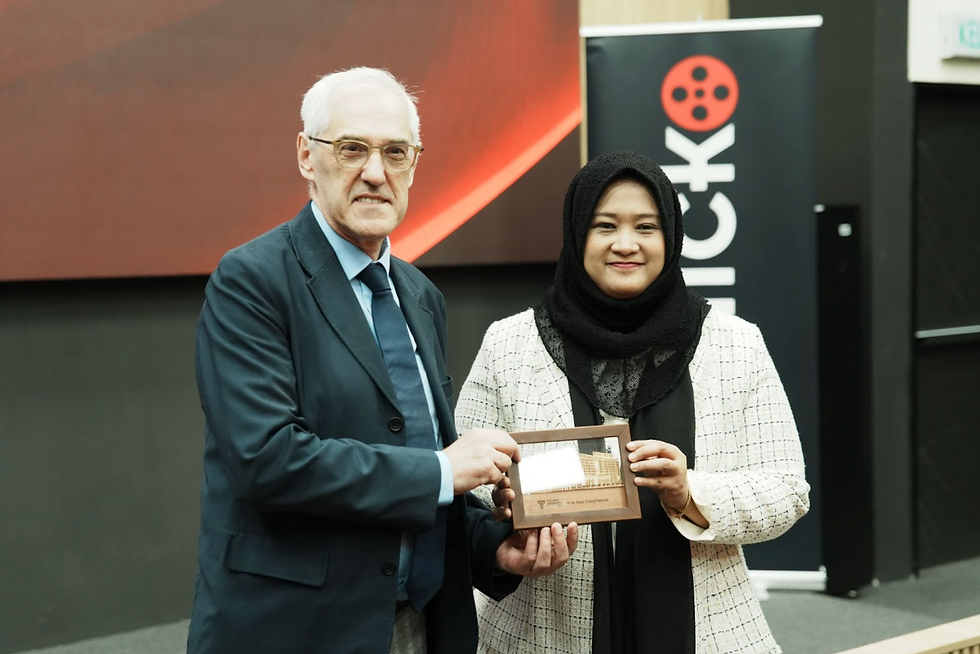
As Mediha observed, youth created content often carries perspectives that established industries overlook. LUMICKO legitimises those perspectives by giving them space– not as novelty but voice.
Despite its technological foundation, the platform’s core argument remains human. Throughout the launch, speakers returned repeatedly to qualities that cannot be automated: emotional intelligence, ethical judgement, storytelling, and responsibility. In an age increasingly shaped by generative systems, these human capacities become more valuable, not less.

LUMICKO does not position technology as a replacement for creativity, but as an amplifier; one that requires intention and care. It invites students to engage critically with tools to understand their implications, and to remain accountable for what they create.
Future phases of the platform promise expanded genres, improved user experience , multilingual accessibility, and IMDb style crediting systems. The LUMICKO team is ambitious to open the platform beyond Taylor’s, potentially transforming it into a national space for youth-created content. With that expansion comes risk: maintaining quality, preserving educational intent, and resisting the pressures of commercialisation.
Yet even in its current form, LUMICKO represents a shift in how education, industry, and creativity intersect. It suggests that the divide between student and professional is less rigid than once assumed; learning does not need to happen in isolation from the world it seeks to enter.
Student work, once confined to classrooms and deadlines, now lives in public. It can be watched, judged, celebrated, critiqued, and remembered. The platform does not ask audiences to lower their standards because the creators are students. It asks them to look closely.
The work is already there, the platform is live, the industries are watching.


Comments