
In Defence of Wonder: Why MPO’s The Nutcracker Might Be the Most Generous Way into the Arts for a New Generation
KUALA LUMPUR–There are some stories we inherit before we fully understand them.
The Nutcracker is one of those stories.
It arrived in December, like muscle memory. Ballerinas from the National Classical Ballet of Moscow fluttered onto the stage at Dewan Filharmonik Petronas, as part of the Malaysian Philharmonic Orchestra’s (MPO) fourth ballet festival presentation of The Nutcracker, on 12th December 2025.

Official Poster For Ballet Festival The Nutcracker. Source: MPO website
For most Malaysians it's their first encounter with a snowy Christmas Fantasy: the swelling strings, falling snowflakes, and the dream logic of a child slipping between worlds. Underpinned by Trachikovsky’s lush and unwavering score, the story follows Clara, who receives a Nutcracker doll from her godfather. As night falls, the ordinary begins to transform, merging reality and dreams. The ballet itself is episodic and colourful, and emotionally legible without being too simplistic. You can observe it as a spectacle– tutus, toys and candy-coloured costumes– or something deeper: a mediation on transformation, memory, and the fragile elasticity of childhood wonder.
The Nutcracker is not profound, nor is it the most technically demanding ballet. There are works with more intricate narratives, more exciting choreography, and scores of greater complexity. What The Nutcracker offers instead is rarer: a return to whimsy, a brief permission to recover the sense of wonder we so often abandon for the real world.
The audience– a mix of first-timers, returning devotees and restless children– was united in by a sense of familiarity and reverence. “This is always the beginning of our festive season,” remarked Marcus, a Canadian expat teacher, who has been attending this production with his family for the last few years, “It’s hard to capture and share the same Christmas magic with my kids, without the show.”
Perhaps The Nutcracker's greatest strength is that it does not demand expertise. Rather it dilates the moment of excitement and childhood awe that so many of us forget; waking up on our birthdays, or Hari Raya, or Christmas morning.
During Act I, I noticed a child seated next to me, giggling at the wind-up monkey, wide eyed at the toy soldiers– utterly engrossed in sections that critics often dismiss as indulgent. In a cultural landscape where ballet and orchestral music are often framed as intimidating or culturally gated, The Nutcracker operates differently; a reminder that magic can come before understanding.
In an era saturated with AI-generated content and a growing disregard for the arts, there was something quietly radical about witnessing a performance so unmistakably human. No two performances are ever the same, and that impermanence is precisely the point. This is what theatre offers that no algorithm can: a shared experience that lives and dies in real time, and stays with you long after the curtain falls.
Stanislav Kochanovsky did not simply keep time; he stretched it. Watching him was as captivating as watching the dancers themselves. He sculpted the air, pulling emotions from silence, elongating moments until time felt elastic. There is a particular magic in witnessing a conductor who understands restraint– who knows that anticipation can be as powerful as release.

Stanislav Kochanovsky conducting Trachikovsky’s Nutcracker. Source: MPO website
Act II unfolds like a love letter to the global imagination; the audience journeys through the Land of Snow and into the Kingdom of Sweets, along with Clara and the Nutcracker Prince. Here the dancers truly shine, each dance distinct yet unified by Trachikovsky’s score. The Asian “Tea Time” dance was energetic and joyful without slipping into caricature; and the Arabian pas de deux (duet)– athletic, intimate and demanding– was one of the evening's highlights, its final hold taut with tension and trust.
Then comes the final Waltz, between Clara and her Nutcracker Prince. Clara appeared in her tutu; the world shifted. The orchestra softened, then swelled. The tone changed– recognisable and intimate. The famous melody emerged and with it a collective intake of breath. The dancers' lines were exquisite; movements fluid and assured. For a few moments the audience was transported.
Here is where the magic of The Nutcracker lies. The ballet itself mirrors the audience watching– the audience is swept away in the magic just as Clara is. This is what makes the final moments in the Kingdom of Sweets so bittersweet for the audience– we know just as Clara that our moments of suspended disbelief are coming to a close, that we are being asked to soon abandon the fantasy for the real world.

Ballerinas from the National Classical Ballet of Moscow along with the Malaysian Philharmonic in motion, during Act II of The Nutcracker. Source: MPO website
For Eliza, a violinist, it was her first time at the ballet, “I was so intrigued by the music, it enters your body,” she gushed, “I didn’t really get the ballet, but I understood what it felt like.”
This is how art works its way in– through sensation.Before you realise it, you are invested, and once you are, you rarely leave unchanged.
Ballet and orchestral music are often framed as elite or inaccessible– relics of a bygone cultural hierarchy. Performances like this challenge that assumption. The Nutcracker is colourful, inviting, and emotionally generous. For young people this offers a rare moment of relief from the experiences mediated by a screen. It is grounding and reassuring to watch a production that is so entirely human, to sit in a hall where everyone– dancers, musicians and audience– agreed to believe in the same dream for a few hours. A respite from the digital age and the all consuming AI slop of our time.
On nights like The Nutcracker, the MPO, delivers on its promise to provide the ultimate music experience.
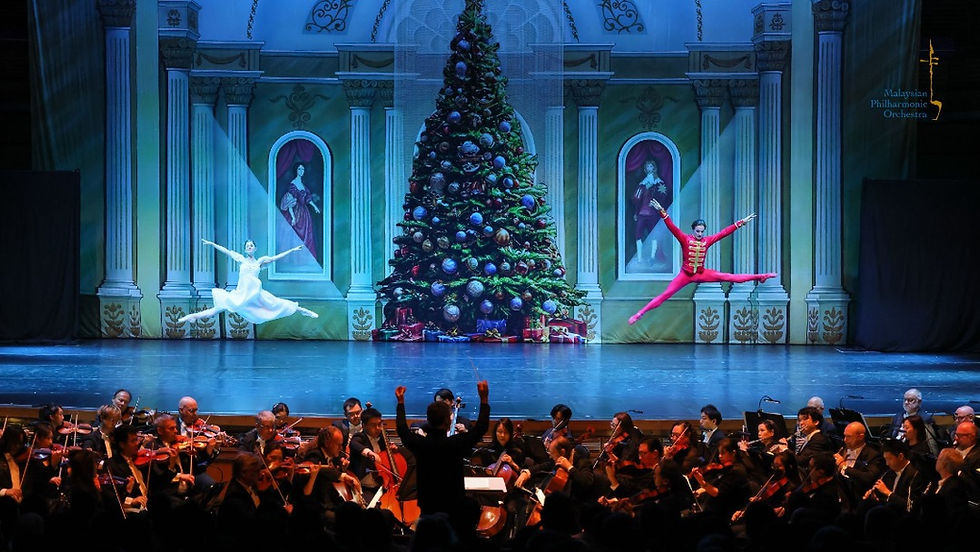
Clara and The Nutcracker Prince Performing above the Malaysian Philharmonic Orchestra, Conducted by Stanislav Kochanovsky. Source: MPO website.
What The Nutcracker gestures toward is a broader appetite for wonder; one that extends beyond tradition and into curiosity. Across the coming 2026 season, the MPO continues to blur the edges of what a symphonic experience can be, allowing classical music to drift into more conversations. These are programs that do not insist on prior knowledge, but on openness; that invite you to feel first, understand later.
Seen this way, the concert hall becomes something other than a once-a-year ritual. If The Nutcracker is the gateway, festive and forgiving, then what follows is the journey itself: one that asks audiences to keep showing up.


Comments